The Astrology of the 1932 Uprising in El Salvador
CW: Talk of injustices and human rights abuses, including sexual violence, genocide, ethnocide. No graphic images are shared.
Todos nacimos medio muertos en 1932
sobrevivimos pero medio vivos
cada uno con una cuenta de treinta mil muertos enteros
que se puso a engondar sus intereses
sus réditos
y que hoy alcanza para untar de muerte a los que siguen
naciendo
medio muertos
medio vivos
Todos nacimos medio muertos en 1932
Ser salvadoreño es ser medio muerto
eso que se mueve
es la mitad de la vida que nos dejaron
Y como todos somos medio muertos
los asesinos presumen no solamente de estar totalmente
vivos
sino también de ser inmortales
Pero ellos también están medio muertos
y sólo vivos a medias
Unámonos medio muertos que somos la patria
para hijos suyos podernos llamar
en nombre de los asesinados
unámonos contra los asesinos de todos
contra los asesinos de los muertos y los mediomuertos
Todos juntos
tenemos más muerte que aquellos
pero todos juntos
tenemos más vida que ellos
La todapoderosa unión de nuestras medias vidas
de las medias vidas de todos los que nacimos medio
muertos
en 1932.
— Roque Dalton
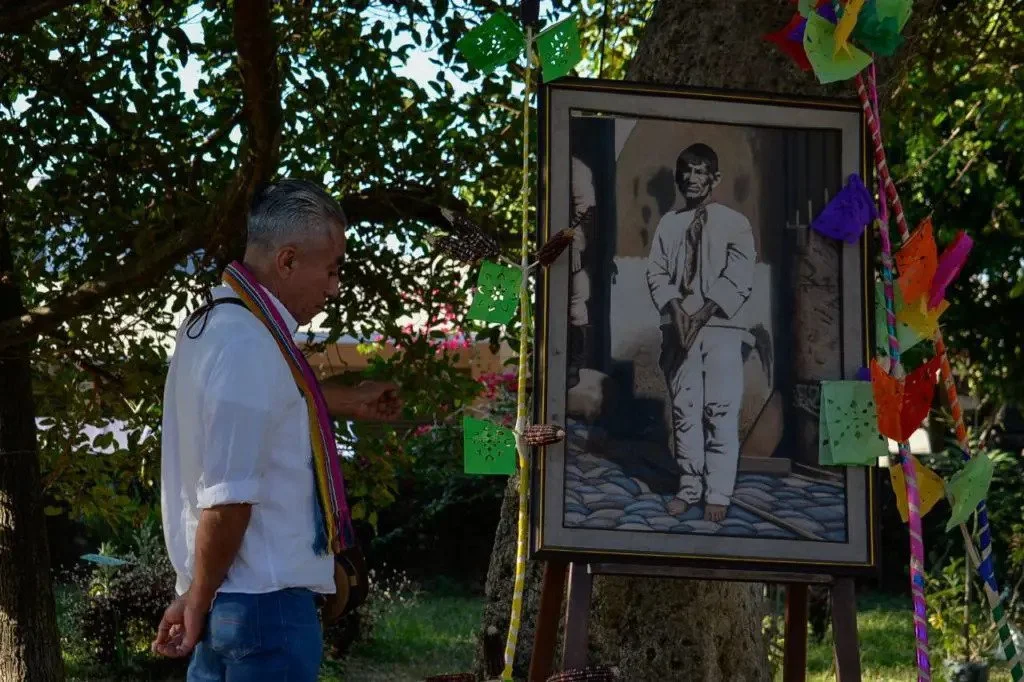
Indigenous communities at El Llanito Parque Memorial in Izalco remembering the victims of the 1932 genocide with an canchule of José Feliciano Ama, one of the communist campesino organizers and leaders of the 1932 uprising.
The 1932 Uprising in El Salvador — also referred to as the Indigenous Uprising of 1932 (el Levantamiento Indígena de 1932 en El Salvador) and the Massacre of 1932 (La Matanza del 1932) — manifested out of the ashes of a debilitating global economic crisis. Between 1929 and 1939 during what became known as the Great Depression, the world experienced a widespread spike in unemployment and poverty from extreme reductions in industrial production and international trade, resulting from the consequences of corrupt banking systems and the extravagances of the “Roaring Twenties”. This economic downturn began with the Wall Street crash of 1929 which initially hit hardest the U.S., the United Kingdom and Germany, then rippled out to the rest of the world through a decline in trade and capital movement, which in turn exacerbated internal weaknesses in many places internationally.
By the 1930s the Republic of El Salvador had a distinct social hierarchy divided by the upper class of wealthy landowners, the middle class of politicians and the military, and the lower labouring class composed significantly of landless Indigenous people. The upper class comprised largely of the Fourteen Families oligarchy that controlled the land. These Fourteen Families had created an economy dependent primarily on coffee production. By 1929 coffee beans accounted for up to 95 percent of all of El Salvador's exports, earning the country the title “The Coffee Republic”. The coffee economy would prove to be the seed of discord increasing inequalities in land and wealth distribution. When the Great Depression hit, coffee producers were no longer able to pay their workers and make profit, leading to many workers becoming unemployed and various coffee plantations failing as a result.
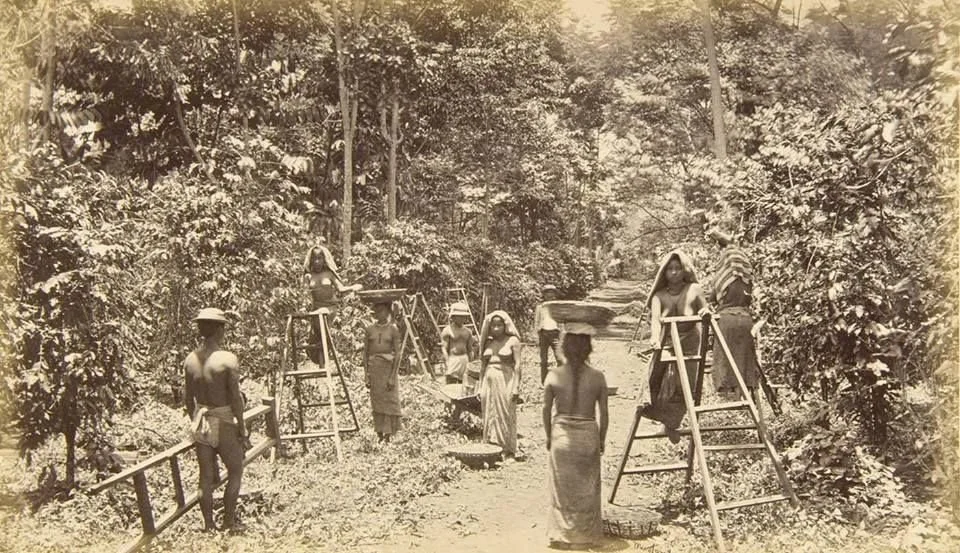
Indigenous workers picking coffee in El Salvador circa 1880s
Conditions were already beyond difficult for the vast majority of the working class prior to this. Indigenous communities including much of the racialized mestizaje castes suffered under rigid colonial laws that prevented land ownership and fair wages to working people. Landowners often paid workers with coins redeemable only at their stores. Women and girls were often subjected to sexual violence and exploitation. A documented complaint was that “the young daughters of the workers can only have relations with the workers once the boss or their sons have abandoned them.”
So in 1920, the Regional Federation of Salvadoran Workers (FRTS) was established by a network of communist and socialist students, teachers and artisans. The FRTS became El Salvador's first trade union to organize campesino (rural) and urban workers. They condemned sexual exploitation at the hands of landowners and demanded equal pay for women and the young. In Nahuizalco, women constituted a third of the FRTS membership. A decade later in 1930, Farabundo Martí (a leftist activist and one of the campesino leaders of the FRTS) along with Miguel Mármol (a shoemaker and leftist activist) founded the Communist Party of El Salvador (PCES). Both Martí and Mármol were well read and experienced leftist activists and Martí had fought alongside Augusto César Sandino in Nicaragua against the United States' occupation at that time.
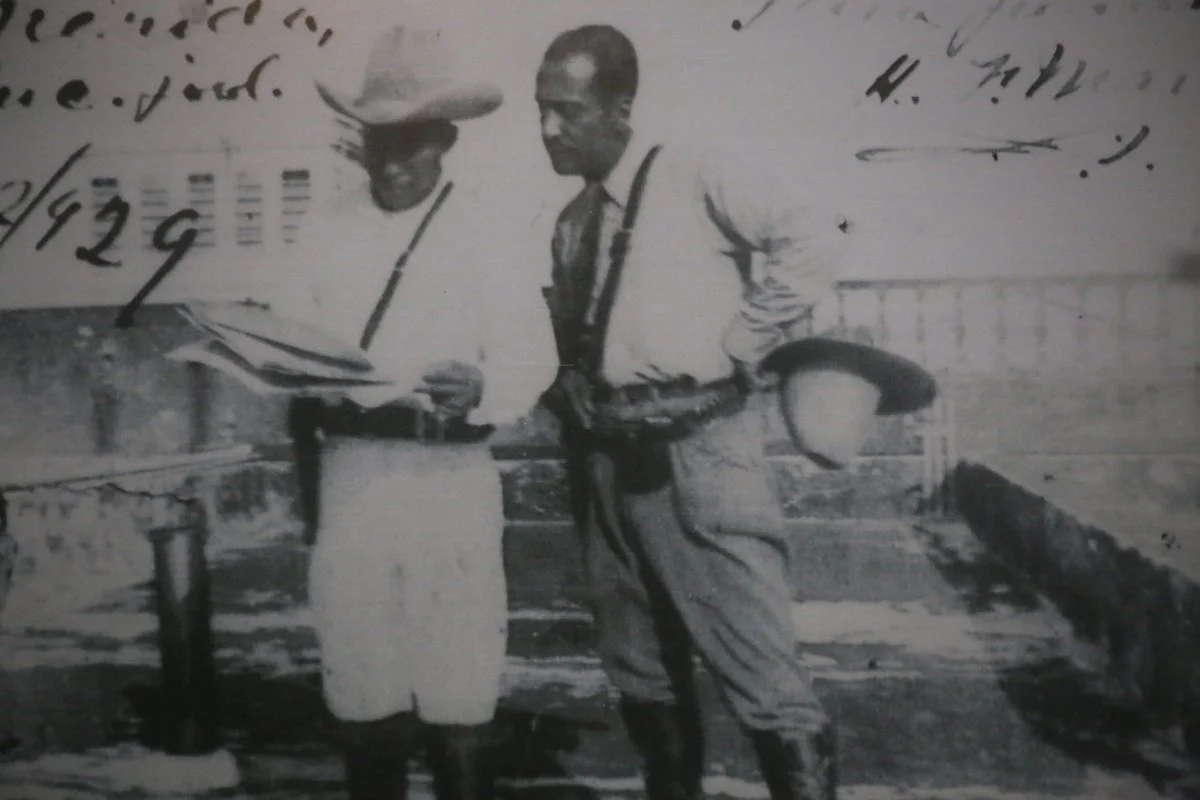
Farabundo Martí, 1929
Within a relatively small timeframe the Communist Party (PCES) gained momentous support from the working class, especially among the campesinos. In early January 1932 the PCES won a number of the municipal elections and polling returns indicated victories for the communists in the legislative elections to take place in mid-January in San Salvador. Because of this the military government that had taken over through a coup d’état on 2 December 1931 decided to null the results of all of the municipal elections and declared non-communists the victors of the legislative elections. The electoral process under the new regime of Maximiliano Hernández Martínez turned violent and a number of communists were assassinated. In an attempt to reach a resolution, a communist commission went to diplomatically negotiate with Martínez but they were not allowed to meet directly with him, and instead were directed to his minister of national defense. In this meeting the commission demanded that substantial contributions to the welfare of the campesinos and working class be met, warning that the people would continue to revolt otherwise. No compromise was reached. In seeing that the regime of Martínez did not allow for fair elections, PCES leaders began organizing a rebellion inspired by the Bolshevik’s 1917 October Revolution.
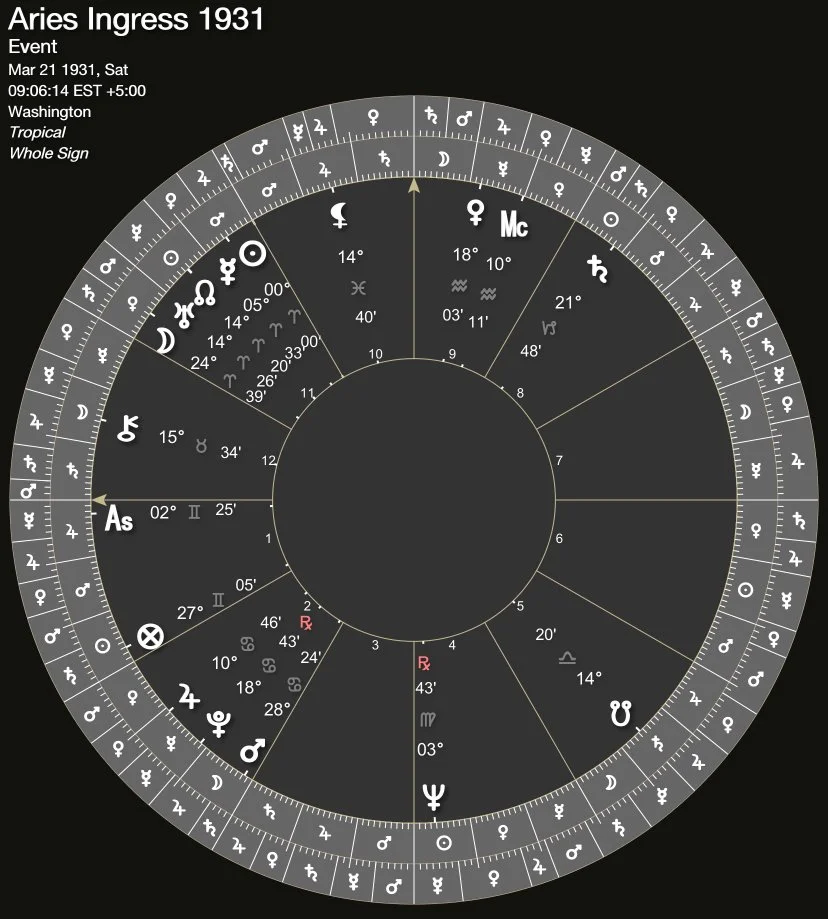
Chart for the Aries Ingress of 1931
Let’s take a look at the astrology to see how these events were being reflected and forewarned. First we take into consideration the Aries Ingress of 1931, for the Aries Ingress indicates the quality of events for the coming solar year. It is generally recommended to cast the chart for the Aries Ingress in the capital of the hegemonic power. In lieu of the Monroe Doctrine of the 19th century the United States had been asserting its dominance in the Americas, preventing European intervention in Latin America. So the chart for the Aries Ingress is set to Washington, D.C.
Gemini is Rising with Mercury combust at 5° Aries copresent Uranus conjunct the North Node at 14° Aries and the waxing crescent Moon at 24° Aries. The preceeding lunation was the dark moon at 27° Pisces trining Mars in Cancer and separating from sextile to Saturn in Capricorn. The proceeding lunation would be a total lunar eclipse at 12° Libra T-squaring Jupiter & Pluto in Cancer with Saturn in Capricorn. We can infer that the solar calendar year began with a rather volatile start. The mutability of the Rising sign for the Aries Ingress also tells us that this instability had its origins in the recent years with the likelihood of it seeping into the next. This was after all still the beginning of the Great Depression.
In the Aries Ingress chart we see that the Aries stellium consisting of Sun, Mercury, North Node, Uranus and the Moon all land in the 11th House of allies, unions and networks, indicating there would be a major focus in militaristic activity for the hegemonic power and its political allies. Indeed, at the start of the Great Depression the U.S. was losing its militaristic grip on Nicaragua which it had been occupying since 1912. At the time, Nicaragua was the main center of unrest against the U.S.’s expanding interests in Latin America.
We also see with the sign of Gemini Rising that the topic of teachers, trade unions and the youth for the hegemonic power would become significant. Mercury is hindered in its combustion and ruled by a fallen Mars in the 2nd House. Mars, Jupiter and Pluto are copresent each other in the 2nd House of resources and sustainability, indicating excessive misspending, major economic losses and political power struggles with Saturn in opposition by sign in the 8th House of external or secondary resources. The year of 1931 ends up foreshadowing the Great Depression’s negative impact on educators unfolding its most dismal years for schools appearing between 1932 and 1936. Gemini being a mutable sign would also indicate that these effects would likely unfold leading into the following year. Significantly the struggles of labor unions would intensify in the coming solar year. The impact of the Great Depression on workers’ unions was severely felt around the world. In many places unions met their end or faced restructuring, while others were newly formed in 1931. Workers’ anxieties would lead to unrest and revolution as unions were often organized around Marxist theory.
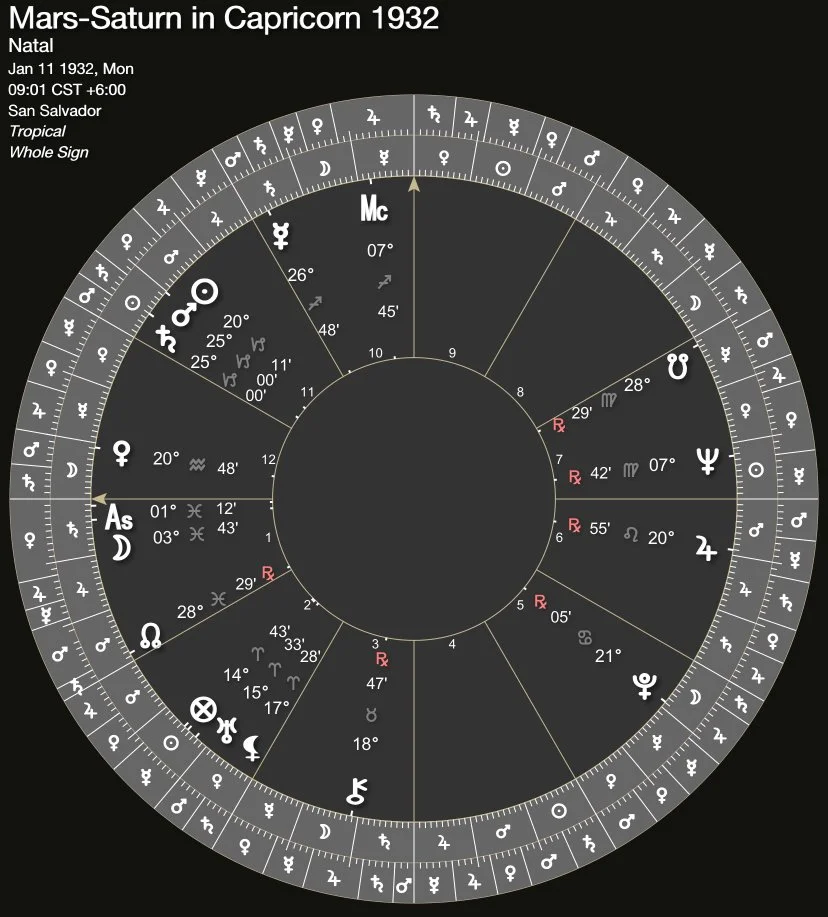
Chart for the 1932 Middle Conjunction in Capricorn
Then we consider that around the time of the municipal elections taking place in El Salvador (which had been postponed due to the coup d’état that put Maximiliano Hernández Martínez in power) there was a new moon in tropical Capricorn copresent a combust Mars applying to Saturn. Mars perfected the partile conjunction with Saturn on 11 January 1932 at 25° Capricorn with Pluto retrograde and in opposition. This Middle Conjunction of Mars & Saturn was combust within five degrees of the Sun. We see that these events were disastrous for the electoral process and society in general despite the support of the people.
What was not fully known at the time but is reflected in the astrology is that Martínez had begun a brutal military dictatorship that would last until his overthrow by yet another military dictator in 1944. Altogether this was the start of a forty-eight year period of military dictatorships that would culminate with the revolutionary struggle and civil war beginning in 1979. The people in 1931-1932, especially the communists and socialists, could nonetheless perceive that this was going to be a continuation of a severely oppressive governmental system and went on to organize their revolt.
In the days following the rigged legislative elections and the communist commission failing to reach a resolution with Martínez’s government, a Communist Party member organizing support from other communists in Guatemala was arrested. Juan Pablo Wainwright was rallying other communists in Guatemala to assist the overthrow of Martínez's government. His arrest collapsed the possibility of armed backup for the rebellion in El Salvador. Then on January 18th, the rebellion’s principal organizers, Martí, Luna, and Zapata were arrested by Martínez’s government and their plans to attack the barracks in San Salvador were seized by the army. On January 21st, the government instructed newspapers in the country to report that a rebellion was planned to occur the following day. It was a set up.
The uprising didn’t begin until late in the evening of January 22nd when a group led by Francisco Sánchez attacked and shut down the telegraph offices in Juayúa at 11:00 p.m. and took control of the town. Other rebels joined forces, capturing the towns of Colón, Nahuizalco, Salcoatitán, Sonzacate, and Tacuba. Historically, the majority of the Pipil were sympathetic to the communists' ideals. Feliciano Ama, an Indigenous leader in Izalco, with a group of Pipil rebels who supported the communists, captured the town of Izalco on January 23rd. Soon after Major Mariano Molina arrived with Salvadoran troops to quel the rebellion and an ethnocide ensued. The military massacred Pipil campesinos and non-combatant civilians, leading to the extermination of the majority of the Nahuatl-speaking population, causing the near total loss of the spoken language in El Salvador. Many of the uprising’s leaders, including Farabundo Martí and Feliciano Ama, were publically executed by the military and several communist leaders fled the country in exile. The total number of those massacred is unknown with some figures estimating around 30,000 unarmed civilians while the military at the time reported “4,800 Bolsheviks were wiped out”.
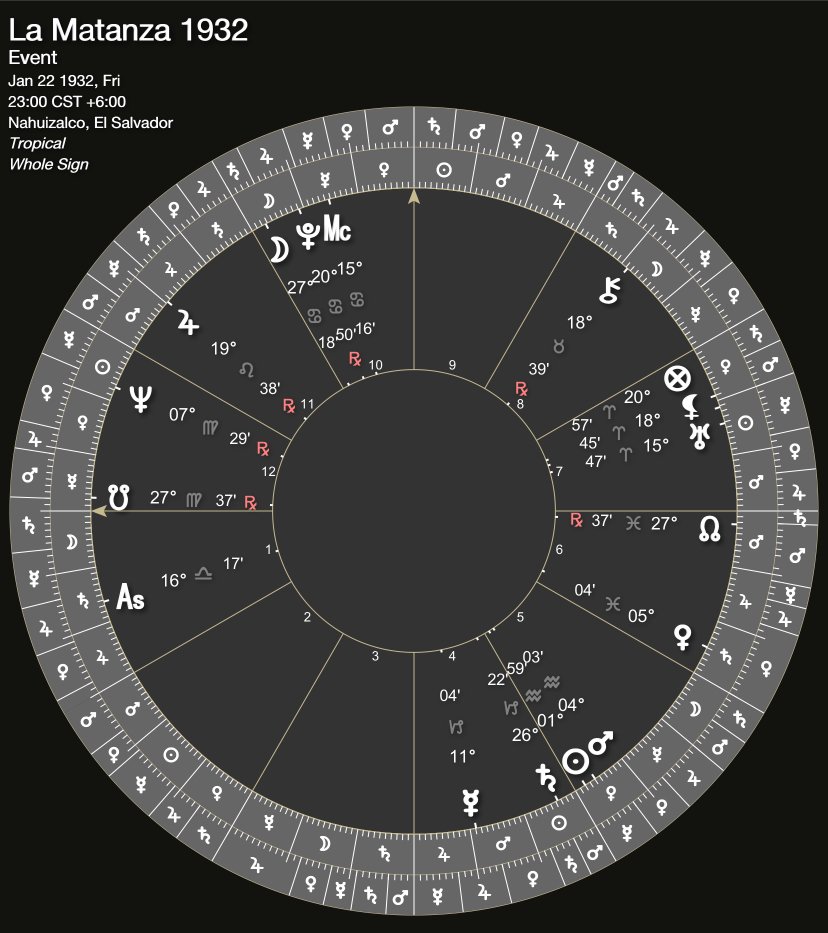
Inception chart for the Uprising of 1932
The astrology for the moment reveals a blood stained sky. The chart of the Uprising which became a Massacre is cast for 11PM local time in Nahuizalco since Juayúa is unlisted in the Astrogold software (Nahuizalco is just south of Juayúa and was also a part of the rebellion). Libra is rising with Venus exalted in the 6th house of enslavement, and both the Ascendant degree and Venus land in Saturn’s terms, Libra’s exaltation lord who is found in the 4th house of land and lineage. Saturn in Capricorn is also squaring the 1st House while Uranus in Aries sets conjunct the Descendant. Interestingly, the Ascendant degree of the Uprising’s inception is also conjunct the South Node of the Aries Ingress chart.
Notice that the levantamiento began in the hours leading up to the full moon. The Moon is also culminating on the midheaven (MC) at the moment of the rebellion’s inception and separating from a conjunction with Pluto retrograde and directly opposing Saturn and separating from a square to Uranus & Fortune in Aries in the 7th House. The culminating Moon reflects the people rising up against their oppressors (Saturn) with Pluto retrograde reflecting their unequal power struggle. Uranus in Aries T-squaring by sign the Moon and Saturn reveals the violent volatility of the moment, with its ruler Mars combust indicating sabotage and failure of the attempt. Saturn in opposition is also indicating a hindrance against the mass revolt (Moon) and its deadly outcome.
The 4th House does not only deal with land and lineage but also imprisonment and hidden matters, secrets and coversion. Mercury is conjunct the lower heaven (IC) applying a square to Uranus and copresent Saturn in the 4th which can also reflect the attack on the telegraph offices that initiated the uprising, as well as the imprisonment of the communist leaders of the revolt prior to its commencement. Mercury in the 4th House squaring Uranus in the 7th also reflects the near extermination of the ancestral language of the land as a result of the massacre which targeted the Indigenous communities who were demanding more dignified living wages and conditions. The Lot of Fortune is also conjunct Uranus and Black Moon Lilith (the apogee of the Moon), throwing violent unpredicatability at its wheel.
Jupiter is retrograde in the 11th House of allies reflecting the lack of support from neighboring communist allies. Jupiter retrograde is also squaring Chiron retrograde in the 8th House, reflecting the lacerating wound that the massacre and ethnocide would leave on the collective memory. Considered one of Latin America’s most pivotal insurrections, the 1932 Uprising in El Salvador is historically referred to as la Cicatriz de la memoria (the Scar of Memory) for Salvadorans. The blood of its martyrs birthed the revolutionary struggle in El Salvador that regained momentum in the 1970s, exploding into the civil war of the 1980s and early 1990s.
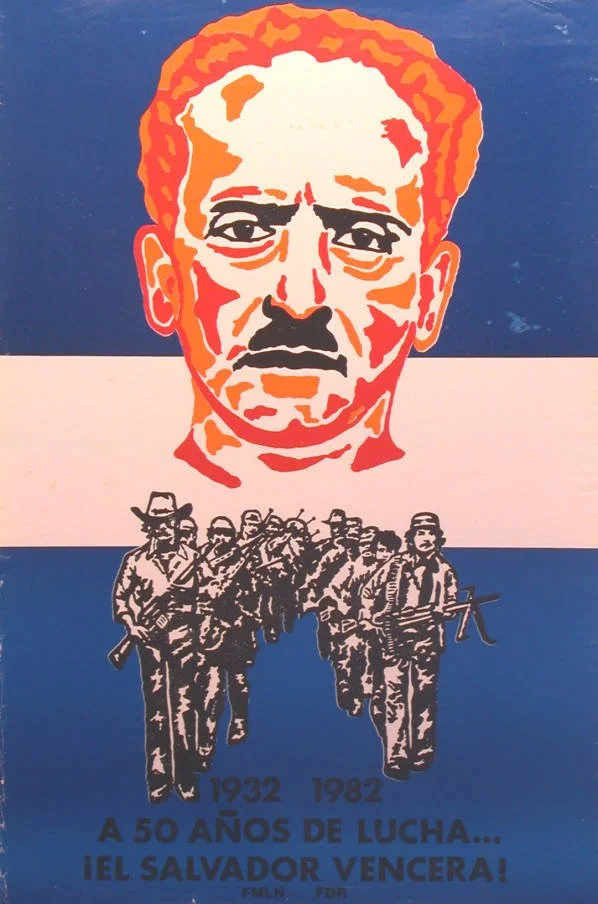
FMLN Front (Frente Farabundo Martí para la Liberación Nacional/Farabundo Martí National Liberation Front) poster commemorating the 1932 Levantamiento
This is one of the first uprisings I analyzed under an astrological lens when I started studying astrology. Both of my maternal grandparents were old enough to remember it — my abuela was only 7 but her family lived in the region and survived the genocide. While my abuelo was 17 and on the other side of the country in Chinameca it nonetheless deeply impacted him. El Salvador is a small country and this insurrection turned ethnocide and genocide would be a formative event in my abuelo’s own political radicalization.
It has taken me some time to put something tangible together so I may edit it further and add more to this article later on, but for now this can serve as an introduction to the research I’ve been compiling on the astrology of uprisings and war in Latin America. I will be releasing more of what’s been piling up in my drafts folder in the coming weeks. My intention with these articles is to grow awareness around these often obscured or whitewashed historical events, to understand them in the context of our shared struggles, while learning what went wrong and in other instances, what went RIGHT so that we may better organize under more auspicious skies.
References
Dalton, Roque. Historias y poemas de una lucha de clases (Stories and Poems of a Class Struggle).
Anderson, Thomas P. Matanza: El Salvador's Communist Revolt of 1932. Lincoln: University of Nebraska, 1971.
Lindo-Fuentes, Héctor; Ching, Erik; Rafael, Lara-Martínez A. Remembering a Massacre in El Salvador: The Insurrection of 1932, Roque Dalton, and the Politics of Historical Memory. UNM Press, 2007.
Sierra Becerra, Diana C. “Resistant Women: Indigenous Women Remember El Salvador’s 1932 Insurrection.” History Workshop, 9 March 2015. https://www.historyworkshop.org.uk/womens-history/resistant-women-indigenous-women-remember-el-salvadors-1932-insurrection/
“El Salvador's Early History: Coffee and Conflict.” California Migration Museum. https://www.calmigration.org/learn-chapter/salvador-history